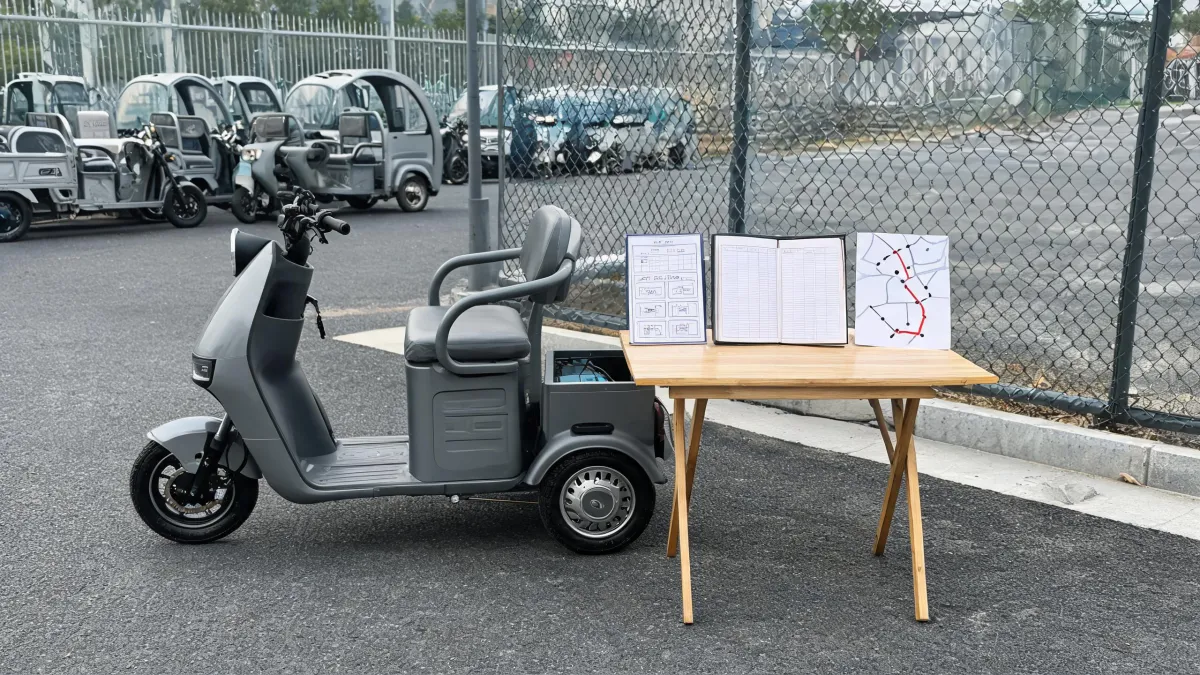
Can you bolt a seat onto a solo cargo trike and call it a passenger trike? No, because the two vehicles are documented differently, and the documents say so in plain language. This article stays with two named machines: the Worksman Bike Chair, an electric front-passenger tricycle, and the Rad Power Bikes RadTrike 2023 US owner manual, a solo cargo trike. Both are specific models, and the conclusions below stay inside them.
The difference comes down to which seating position the manufacturer rates for a person. Wheel count, motor size and battery capacity do not decide it. A maker who documents one position as a seat and every other flat surface as cargo has built a passenger vehicle. A maker who documents the whole machine as single-operator has built a cargo vehicle, and adding upholstery does not rewrite the rating.
What an Electric Front-Passenger Tricycle Is
On the Worksman Bike Chair product page, the layout fits in a sentence: an adult passenger sits securely in front while a caretaker or rider pedals and steers from the rear. That line carries most of the definition. The vehicle is a three-wheeler with the passenger position ahead of the operator, and the operator's station sits aft, doing the pedaling and the steering.
The same page names who the machine is built for, listing caregivers, families and care facilities, and describes the aim as enjoying the outdoors together, bringing fresh air, movement and stimulation to passengers who may otherwise have limited mobility or independence. Read that as a claim about one named model, not a rule for a category. Trikes that look similar exist and are rated for the operator alone, so the definition you can actually use is narrower: a front-passenger tricycle is a trike whose maker puts an adult passenger seat up front and writes the vehicle around that seat.
Why the Passenger Sits in Front, Not Behind
Here is the thing about the seating order: the operator keeps pedaling and steering from the rear, so a seat placed behind the operator would put the passenger's face into a back and a rear wheel. Ahead of the handlebars is the arrangement that leaves them looking forward at the road. Because the person doing the work is also the person facing the machinery, the passenger gets a clear view and the operator keeps hands and eyes where they belong.
The reason this layout exists at all is social, not structural. Riding up front, as the Bike Chair page puts it, encourages connection, conversation and engagement with the world, while the caretaker gets a comfortable and intuitive ride. That is the whole point: the forward seat is doing a conversation job, not a hauling job. Which means that when you size up one of these machines, the questions worth asking are about the passenger's view, the boarding step, and whether the operator can hear and see the person in front of them, rather than about deck length or tie-down points.
What a Solo Cargo Trike Is Actually Rated For
The RadTrike 2023 US owner manual goes the other way, and every statement below belongs to that model and that model only. It says the trike is not designed to carry passengers and that its rear rack is not compatible with the Thule Yepp child seat. It tells owners not to allow anyone to ride, sit or stand on the rear rack. In a danger callout it states that only one person, the operator, should be on the trike at a time.
The manual goes further than a simple no. It states that transporting a passenger, meaning any person in addition to the operator, can result in serious injury or death to either or both of them. That danger line and the child-seat line push in the same direction from two angles, because the workaround almost always starts at the rack: someone sees a flat platform and pictures a carrier on it. What the document describes is a cargo deck plus exactly one rated seat.
The Real Difference Is the Rated Seating Position
Line up the two machines and the spec items buyers compare first turn out to settle nothing. Three wheels, a motor, a battery and a frame show up on both. What separates them is which position the maker rates for a person. Because the RadTrike manual writes off the rear rack as a place nobody may ride, sit or stand, that rack is a load platform in the manufacturer's own words. The same manual caps occupancy at the operator, which means the saddle is the only rated seat on the vehicle.
The Bike Chair is built from the opposite starting point. Its description begins with an adult passenger seated securely up front, so the seat and the rating arrive together, and nothing on that page describes the front position as cargo. Which means the question to carry into any showroom is which positions the maker has written down as seating, not how many wheels or how large the motor is. A trike with a passenger-rated front seat and a trike with a cargo-rated rear deck are different products even when the tubing looks identical.
Why Buyers, Fleets and Wrench-Turners Should Care
If a solo cargo trike's manual caps occupancy at the operator and calls passenger transport a serious-injury risk on that model, then bolting on a seat moves the vehicle outside its stated use, and the exposure lands on whoever did the bolting. For a household buying around an elderly parent, that is the gap between a vehicle designed around a second person and one that merely has room for them. For a fleet, passenger duty needs a vehicle whose own documentation covers a passenger, and the way to find out is to ask the supplier for that model's documentation instead of inferring it from photographs.
Maintenance readers get a version they can use at the bench. The front passenger seat on a purpose-built machine and the rear rack on a cargo trike are not interchangeable furniture; they are different rated zones with different loads behind them. Because one is documented as a seat and the other as a no-occupancy zone, the hardware underneath each is answering to different assumptions, and moving parts between those zones is guesswork wearing a work glove.
What to Confirm Before You Specify One
Suppose you are quoted a front-passenger tricycle for a care facility and want the thing on the invoice to match the thing in the manual. Three questions do most of the work. Ask whether the exact model and version you are quoted is rated to carry a passenger, ask whether the passenger seat ships as part of that version or arrives as an add-on, and ask whether the installed equipment matches the version the documentation covers.
Consider the same three questions pointed at a cargo trike you already like. If the answer to the first one is no, no accessory changes it, and the other two stop mattering. The limit here is narrow on purpose: what this article covers is two named machines, the Bike Chair and the RadTrike 2023, so an answer given for one tells you nothing certain about a third. That is where buyers get hurt on this topic, by assuming a category behaves like the sample in front of them.
Choosing a purpose-built front-passenger trike buys you a second person seated up front and facing forward, on a vehicle whose own paperwork treats that seat as a seat. It costs you the cargo-first layout, the single-occupant simplicity, and the much wider field of models that solo cargo trikes put on the table. If carrying a person is why you are buying, pay for a vehicle rated for that person; if hauling gear is why, buy the cargo machine and spend the difference on tie-downs.
