-
Where the Three-Wheel Layout Sets Your Limits
-
Brake to Corner Speed Before the Bars Move
-
Which Hand Owns the Front Brake
-
Downhill Speed Comes From Gentle, Held Pressure
-
Approach Speed at Turns and Intersections
-
Two Riders, One Braking Plan
-
How You Know the Plan Worked
-
What the Manual Leaves You to Ask the Dealer
Plan the stop before you plan the turn. On the Worksman Side by Side Team Dual SBST-0921, you finish shedding speed on the straight and then point the trike through the corner; the reason is that the manual ties its flip warning to over-steering while moving too fast, not to steering itself.
The exception sits on the downhill leg. The same manual calls for gentle brake pressure held through a descent instead of one hard grab, and it treats steep grades as outside the design brief: this trike was built for relatively flat roads. Everything below stays inside that one model and one owner manual.
Where the Three-Wheel Layout Sets Your Limits
The manual describes the steering as car-like and states that the SBST has a wider turning radius than cycles with an upright riding position, then caps it with a plain instruction to always turn slowly. Read those lines together and the geometry sets your budget. A wider radius means the front wheel has to trace a longer arc, so the trike stays in the corner longer than a two-wheeler would, and the time you spend with the bars turned away from straight is the time the vehicle is least settled.
The flip warning explains why that matters. Over-steering while moving too fast can cause a three-wheeled vehicle to flip over. The reason it is speed-dependent rather than angle-dependent is that sideways demand on the tires rises with speed while the trike's footprint stays fixed, so the same steering input that is harmless at walking pace becomes a different event at a higher speed. Which means the number you plan around is your speed at the instant the bars move, not the steering angle on its own.
There is also a fixed travel boundary at the front. Even with the pulling tendency, the trike can only go where you point it. That line is worth keeping in mind because it removes the excuse of blaming the machine for a wide line: the front wheel decides the path, so a rider who arrives at the corner with too much speed and then adds steering angle gets exactly the outcome the warning describes.
Brake to Corner Speed Before the Bars Move
The order is fixed, and each part has a line behind it. You read the road first, because the manual opens with always look around you to understand the riding environment and hazards. Then you shed speed on the straight, since it asks you to slow down when approaching turns or intersections, and only after that do you add the slow, car-like steering input. If the road is dropping away, the fourth habit is light, held brake pressure through the grade rather than one hard grab.
The sequence is not a preference. Steering multiplies whatever speed you carried into it, and the warning is specifically about over-steering while moving too fast; that is why the braking belongs before the bars move, not during. Do it the other way round and the front wheel is already committed while you are still scrubbing speed, which is the one combination the manual singles out.
Which Hand Owns the Front Brake
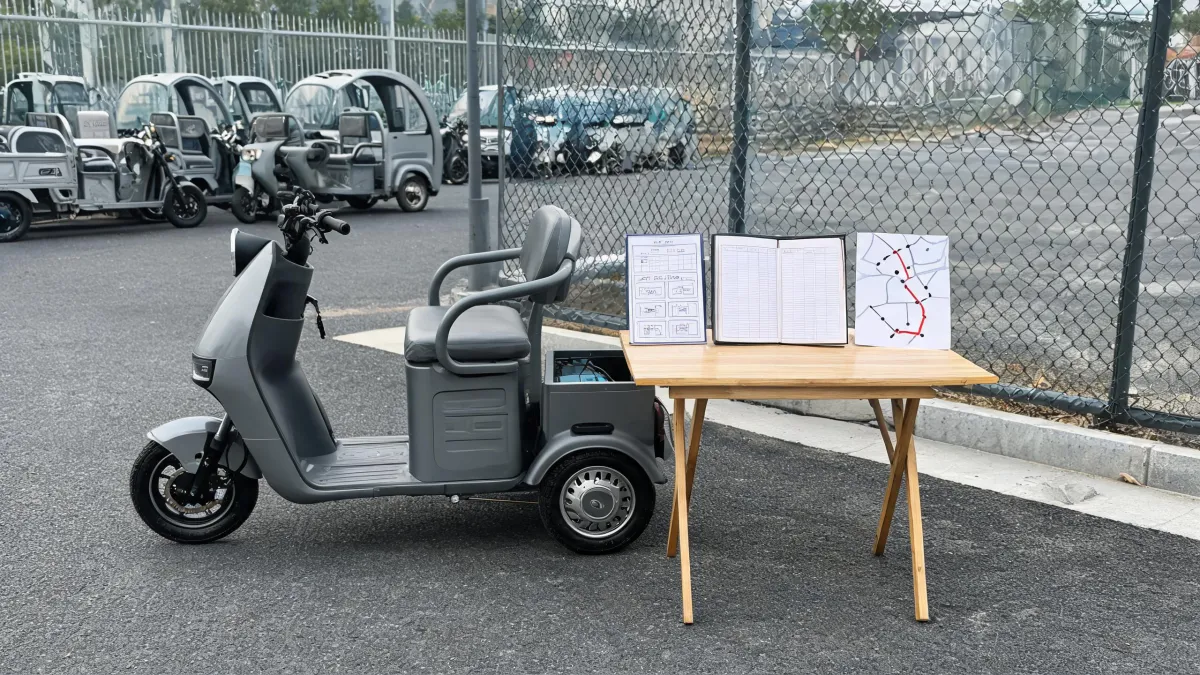
The hand brake lever for the front brake, drum on the non-motorized build and caliper if motorized, sits in the center of the handlebar. It is a right-hand lever, positioned so the rider on the left can use it with their right hand. That placement tells you something that matters more than it first looks: the person working the front brake is not automatically the person doing the steering.
Name the braking hand before the wheels turn. The lever is set up for the left-seat rider's right hand, which means the left seat is the braking position on this model unless the pair decides otherwise out loud. In a cockpit where both occupants have bars in front of them, a silent assumption about who is on the brake is the kind of thing you discover mid-corner.
Downhill Speed Comes From Gentle, Held Pressure
This model is designed for relatively flat roads, and the manual says plainly not to operate a tricycle on steep grades. On the grades it does allow, the instruction for the descent is gentle brake pressure to control descent.
Gentle and held is the opposite of one hard grab, and the reason is mechanical. A grab removes speed in a step and then releases it, so your speed pulses; each pulse changes how much steering input the front wheel needs, and you end up correcting the bars repeatedly on a surface that is already trying to pull you off line. Held pressure keeps speed roughly constant, which means the correction you made a moment ago is still valid a moment later.
That makes the grade limit a route-planning question rather than a skill you can train around. If your regular route needs a steep descent, no amount of braking technique turns this into the right vehicle, because the manual has already drawn the boundary.
Approach Speed at Turns and Intersections
That wider arc changes when the slowdown starts. The trike is still tracking through the corner after a two-wheeler would have been out of it, so you begin braking earlier than bike instinct suggests, and you finish before the bars move.
Signalling is the other half of the entry. Use proper hand signals when turning or stopping, and keep in mind that tricycles are meant for slow-pace rides, not for racing. That is the whole trick on this vehicle: the hand goes out before the brake hand leaves the grip, because once the turn begins both hands are back on the bars. Commit to the signal early, with no last-second waving as you tip in, and you keep room to make the turn at a speed the front wheel can actually hold.
Intersections add a second variable: surface. Ride only on smooth, paved surfaces, so a turn that crosses a gravel apron or a patched lip is not a corner you plan a quick entry for. Enter slowly, point through, and put your hands back on the grips before the turn is finished.
Two Riders, One Braking Plan
Both riders must understand the vehicle's operation. That is a manual instruction, not a courtesy, and it changes what a pre-ride conversation has to cover: who calls the slowdown, who holds the front brake, and what the call sounds like.
The passenger load is fixed too, since the manual says not to carry anyone other than the two riders seated. Two seats means two briefed people, and the briefing is not about etiquette. A two-seat tricycle has no shared pedal and no shared brake, so the only link between the two occupants' intentions is speech.
Imagine a depot yard where the same trike is used by three different pairs across a shift. The plan that survives is the one said out loud at handover and written down where the keys live, because the left seat's right hand is on the front brake and the other rider needs to know that before the first corner, not after it.
How You Know the Plan Worked
You can check the whole sequence from the saddle without instruments. Braking finished before the bars moved. No grab happened once the trike was turning. Both hands were back on the grips through the corner, rather than one hand signalling while the other worked the lever. Descent speed stayed steady instead of pulsing. The second rider can repeat the handover brief without prompting.
Two pre-ride items belong on that same check. The manual asks you to check shoelaces before riding so they do not become engaged in the chain and sprocket, and to replace worn parts with genuine Worksman Cycle Repair Parts. Both are braking items rather than housekeeping, because a fouled drivetrain or a tired lever changes what any brake plan can actually deliver, and the plan assumes the hardware is doing its job.
What the Manual Leaves You to Ask the Dealer
The document quotes no stopping distance, no grade percentage, no lever free-play figure and no wear interval. If a number like that turns up in a listing or a sales conversation, it did not come from this manual and should not be treated as though it did.
Ask instead about the things the manual leaves open. What is the actual grade on the ramp or driveway this trike will use daily? Which brake parts are stocked locally, and does the delivered unit carry the brake type named for it, drum on the non-motorized build and caliper if motorized? Who signs off the two-rider briefing, and is that sign-off recorded anywhere?
Suppose a fleet is buying for a site with one loading ramp that has to be climbed and descended several times a day. That is the case where the flat-road limit decides the purchase rather than the technique, because a trike can be ridden correctly and still be the wrong vehicle for that route.
Go back to the scene you started with: two riders, one brake lever, one route with a single grade on it. If the route needs that grade, this is a vehicle-selection question and no technique fixes it. If the route is flat, the plan is brake first, point second, gentle and held on the way down, and both riders should be able to say that order back before the wheels move.
