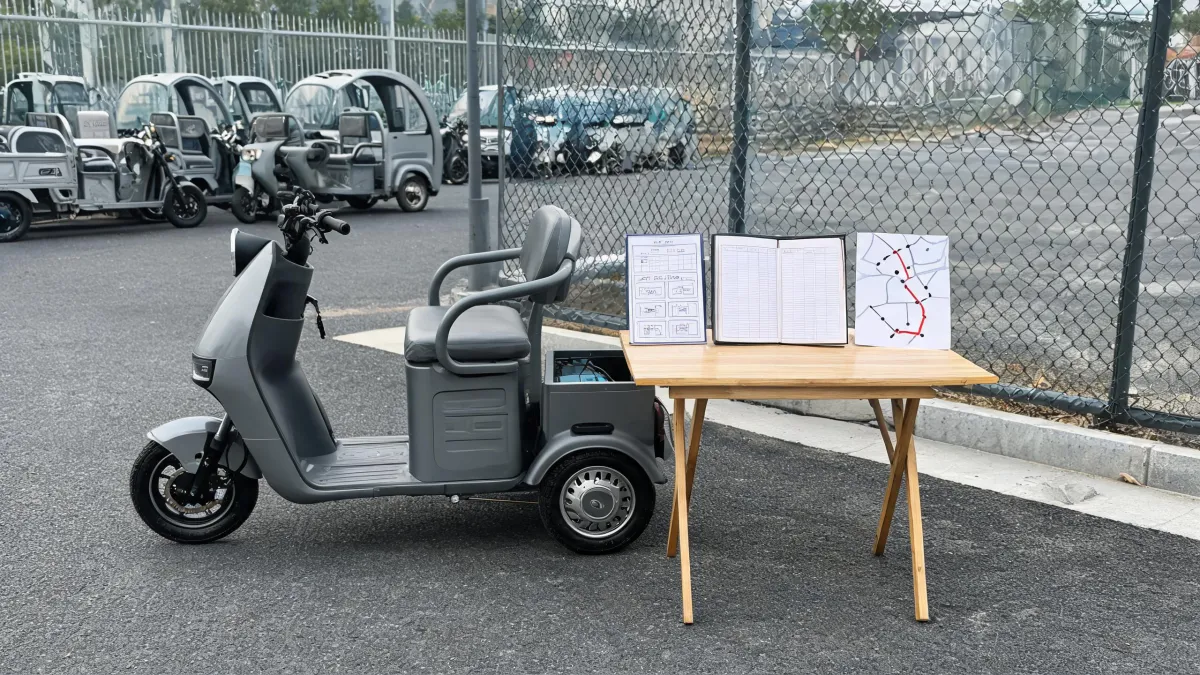
A bad role split on a side-by-side trike never announces itself. It shows up mid-turn, when two people decide at the same instant that the vehicle is drifting wide: one rider pulls the bar back toward the line, the other reaches for a brake, and the machine gets two corrections where it needed one. On the Worksman Side by Side Team Dual SBST-0921 — the model this article stays inside — over-steering while moving too fast can cause a three-wheeled vehicle to flip over, and a front brake that a rider cannot reach cleanly turns a planned stop into a late one. Neither failure is expensive to prevent before the wheels move. Both are expensive afterward.
The split that holds up is small and unglamorous. One captain owns steering, front braking and shifting. One navigator owns hazard observation, route width, and the conditions the SBST-0921 manual puts on where the trike may go. Two trained riders, two jobs, no shared controls. What follows is the order to set that up in, the lever placement that explains why the default lands where it does, and the questions that confirm the handover before anyone pushes off.
The Cost of Two Riders Sharing Control
The SBST-0921 steers like a car, and the instruction attached to that is to always turn slowly; the same passage notes that trikes in this layout carry a wider turning radius than cycles with an upright riding position. A wider arc takes longer to complete and stays visible long enough for the second rider to form an opinion about it, which is exactly the window where a second hand arrives on the bar. And the bar is the whole story of direction: even with a pulling tendency, the trike goes where you point it. A second hand there does not steady the machine. It introduces a competing answer to the only question that matters in a turn.
The consequences are not symmetric. Over-steering at speed can put a three-wheeler on its side, so one wrong correction is not a wobble that sorts itself out — it is a rollover, and rollovers take vehicles out of service and people out of the seat. Braking has the same shape of problem. The hand lever for the front brake sits at the center of the handlebar, and it is a right-hand lever positioned so the rider on the left can use it with their right hand. Two riders reaching for one lever at the center of the bar is a reach conflict before it is ever a braking problem.
Suppose a rental or shift-change handoff on a wide indoor route, where two riders climb aboard and neither says who is driving. The trike rolls into a corner, both riders feel the same drift, and each waits a beat for the other to brake. That extra beat is the entire failure: nothing measured here, no test data, just the shape of what happens when a vehicle with one set of controls has two operators. Control has to be assigned before the trike rolls, because the failure mode appears precisely when two people act on the same input at the same moment.
Assign the Captain Before the First Move
Five things get settled in order, on the spot, before anyone pushes off. Only the two seated riders are aboard — the manual limits the vehicle to those two. Both of those riders must understand how the SBST-0921 operates and how it stops. One of them is then named captain out loud. The controls get divided along that line: the captain takes the bar, the front brake and the shift, and the navigator takes the environment. The navigator's first assignment is the route itself.
When two riders correct the same slow corner at once, one pulling the bar back toward the intended line while the other reaches for a brake that neither has claimed, the vehicle gets two inputs at the instant it can least afford them; a corner that should have been unremarkable becomes the failure the manual warns about. Name the captain before the trike rolls.
Both riders understanding the machine is a precondition rather than a courtesy, because the navigator has to read route width, surface and sight lines against a vehicle whose turning radius is wider than a bicycle's. The captain is on the controls. The navigator is on the route.
Left Seat, Right Hand, Front Brake
Reach decides the seating, not tradition. The front-brake lever on the SBST-0921 is at the center of the handlebar and it is a right-hand lever, designed so the rider on the left can work it with their right hand. The reason that matters comes down to distance and grip: a hand already at the lever can pull it without leaving the bar, while a hand crossing the bar to find it has to compromise its hold. Which means putting the captain in the left seat keeps steering and front braking inside one pair of hands.
Two conditions need checking rather than assuming. The brake itself varies by build — drum if the trike is non-motorized, caliper if it is motorized — so confirm what is actually installed on your unit before planning around it. A right-seat captain is a deliberate exception that separates steering from front braking, and the crew should make that call on purpose and say so out loud, rather than discover it in the first corner.
Who Watches the Route
The navigator is not a passenger with a good view. Looking around to understand the riding environment and its hazards is a standing job on this vehicle, and it is a job that cannot be done by whoever is holding the bar through a turn. Route width belongs to the navigator too, since the route has to be wide enough for the SBST, and so does the manual's line that the trike is not ridden outdoors at night. Both riders slow for turns and intersections; the navigator is the one who sees the turn coming early enough for that to mean something. Because the vehicle is limited to the two seated riders, the second person is a trained observer with a specific job — which means the navigator reports and the captain acts, rather than both hands converging on the same controls.
Shifting Without Reaching Across
A shift takes a hand off the bar, and the instruction for it is specific: one hand stays on the handlebar while the other shifts. Because that is the geometry of the task, the person shifting should be the person already steering, not the navigator reaching across a captain who is mid-correction. The bar remains the only thing aiming the vehicle even with the pulling tendency, so a navigator's hand crossing the centerline during a shift is competing for space exactly where steering is decided. The captain owns the shift. A crew that cannot work that way — because the strongest rider is in the right seat, or because someone is used to shifting from the passenger side — has built a two-driver control split and should swap seats before moving rather than manage it while rolling.
Confirm the Handover Before Moving
A handover is confirmed with questions, not nods. Both riders can say out loud who the captain is. Both can explain how the vehicle operates and how it stops. Only two people are seated, nobody standing on a step or riding along. The captain can reach the center-mounted front-brake lever with their right hand without leaving the bar, on the seat they are actually in. The navigator knows the route is wide enough for the trike and knows the outdoor-at-night restriction. Both riders know to slow for turns and intersections and know that a fast, over-steered turn is the rollover risk on a three-wheeler.
This is a briefing check, not an inspection routine: it does not replace the maintenance log the same manual asks you to keep for the vehicle, and it does not test brakes or anything else mechanical. It answers one question — does every person aboard know which job is theirs — and a crew that cannot answer it clearly has not finished the handover, whatever they agreed to verbally.
Who Should Not Use This Split
This assignment is not for a solo rider, because there is no second trained person to act as navigator and no reason to invent one. It is not for a crew that wants to share the bar, the brake or the shift as co-drivers, and it is not for a route too narrow for the SBST-0921 or one that ignores the outdoor-at-night restriction. It is not for a third passenger, since the manual limits the vehicle to the two riders seated. It is for a two-person crew that will name a captain and treat the navigator as a second trained set of eyes for the whole trip. The tradeoff is real: one captain cuts conflicting inputs but concentrates control in one pair of hands, so the navigator has to be trained well enough to speak early and be heard the first time.
